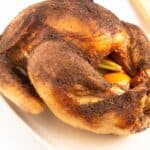
Slow Roasted Turkey
This slow roasted turkey is a dry brined whole turkey roasted low in the oven at 225℉/107℃. Cooking it low and slow lets the breast and the dark meat finish perfectly at the same time.
Servings: 14 servings
Calories: 339kcal
Equipment
- Roasting pan with a rack
Ingredients
Turkey and Dry Brine
- 1 whole turkey about 18 pounds; neck and giblets removed and saved in a bag in the refrigerator
- ½ tablespoon fine grain sea salt or kosher salt for the cavity; use a little less if using table salt
- ½ tablespoon black pepper for the cavity
- 1 tablespoon fine grain sea salt or kosher salt for the outside; a light coating, about ½ tablespoon over the top and the rest on the sides; use a little less if using table salt
Cavity Aromatics
- 1 carrot
- 1 onion
- 1 head garlic no need to peel; cut so the cloves are exposed
- 1 stalk celery
- 1 navel orange cut into quarters
- 1 to 2 bay leaves
Magic Spice Blend
- 1 teaspoon celery seed ground fine with the rosemary
- ½ teaspoon fennel seed
- ½ teaspoon rosemary leaves ground fine with the celery seed so it does not burn
- 1 teaspoon granulated garlic not garlic powder
- 2 teaspoon onion powder
- 2 teaspoon ground coriander
- 1½ teaspoon ground thyme
- 2 teaspoon coarse black pepper
- ½ teaspoon nutmeg
- 1 teaspoon ground marjoram
- 1 tablespoon brown sugar
- 1½ tablespoon sea salt or kosher salt
For Roasting
- 2 cups water or turkey or chicken broth
- ½ cup butter melted, for brushing before crisping the skin
Instructions
- Remove the neck, gizzards and anything else packed inside the turkey. Put them in a bag and refrigerate them; they go under the turkey later to flavor the drippings for the gravy. Rinse the turkey or not, whichever you prefer. Set the turkey on a tray in the sink.1 whole turkey
- Season the inside of the cavity with ½ tablespoon of fine grain sea salt or kosher salt and ½ tablespoon of black pepper. If you are using table salt, cut the salt back a little.½ tbsp fine grain sea salt or kosher salt, ½ tbsp black pepper
- Do not pat the skin dry; leave it a little damp so the rub will stick. Sprinkle a light coating of fine grain sea salt or kosher salt over the top of the turkey, about ½ tablespoon, and lightly coat the skin. Lift the turkey and sprinkle the sides, using about 1 tablespoon of salt in all. Seasoning the underside is optional. Leave on any skin flap and the plastic piece that holds the legs together; they keep the turkey in a beautiful shape.1 tbsp fine grain sea salt or kosher salt
- Stuff the cavity with the carrot, onion, garlic (cut so the cloves are exposed) and celery, plus 3 of the orange quarters. Tuck 1 or 2 bay leaves in, one on each side, and set the last orange quarter at the front of the cavity.1 carrot, 1 onion, 1 head garlic, 1 stalk celery, 1 navel orange, 1 to 2 bay leaves
- Make the magic spice blend. Grind the celery seed and rosemary in a mortar and pestle or a spice grinder until fine so the rosemary does not burn and turn bitter. Stir them together with the fennel seed, granulated garlic, onion powder, coriander, thyme, coarse black pepper, nutmeg, marjoram, brown sugar and salt.1 tsp celery seed, ½ tsp fennel seed, ½ tsp rosemary leaves, 1 tsp granulated garlic, 2 tsp onion powder, 2 tsp ground coriander, 1½ tsp ground thyme, 2 tsp coarse black pepper, ½ tsp nutmeg, 1 tsp ground marjoram, 1 tbsp brown sugar, 1½ tbsp sea salt or kosher salt
- Set the turkey on a rack in a roasting pan so the juices do not sit against the skin. Sprinkle the spice blend over the turkey the same way you did the salt, then gently pat it in. If the skin is very dry, spritz it with a little water first. Do not use an oil or mayonnaise binder; salt will not dissolve in fat. Turn the turkey to season the other side, using all of the rub.
- Refrigerate the turkey, uncovered, on the rack for 24 to 48 hours.
- When you are ready to roast, lift out the rack and rinse the roasting pan so no salt or rub is left sitting in it. Return the rack and turkey, and tuck the neck and giblets underneath. Pour 2 cups of water (or turkey or chicken broth) into the bottom of the pan. If the turkey looks a little blue after dry brining, that is perfectly normal.2 cups water
- Insert a probe thermometer into the thickest part of the thigh, between the thigh and the leg, without touching the bone. Place an oven thermometer in the oven to make sure it runs at the set temperature. Roast at 225℉/107℃.
- Check the temperature at about 3 hours. The turkey must reach 140℉/60℃ within 4 hours for food safety. If it is still around 120-125℉/49-52℃ at 3 hours, raise the oven to 250℉/121℃ until it reaches 140℉/60℃, then lower it back to 225℉/107℃. For a turkey larger than 18 pounds, you may want to start at 250℉/121℃.
- Continue roasting until the thigh reaches 165℉/74℃. Expect about 4 to 5 hours or a little longer; an 18½ pound turkey took 3½ hours to reach 140℉/60℃ and 5 hours 15 minutes in total. There is very little carryover heat with this low temperature, so the turkey will not climb much after it comes out.
- Remove the turkey from the oven. It can sit at room temperature for up to about 1½ hours while you heat your sides, as long as it stays above 140℉/60℃. Preheat the oven to 400℉/200℃. Brush the turkey with ½ cup of melted butter.½ cup butter
- About 15 minutes before serving, return the turkey to the oven and crisp the skin, watching so it does not burn.
- Let the turkey rest for 10 to 15 minutes. Remove the aromatics from the cavity. For gravy, add about ½ cup of water to the roasting pan and loosen the browned bits from the sides into the drippings. Carve and serve.
Notes
PREP TIPS
• The 24 to 48 hour dry brine in the refrigerator is hands-off time and is not included in the total time.
• Leave the skin a little damp. If it is too dry, the spice rub will not stick.
• Season the turkey on its rack over the roasting pan, then rinse the pan out before roasting so the drippings for the gravy are not too salty. COOKING TIPS
• For food safety, the turkey needs to pass 140℉/60℃ within 4 hours. Check it at 3 hours.
• Place the probe in the thickest part of the thigh without touching the bone, which will throw off the reading.
• The total time is not exact. It depends on the size of the turkey, its starting temperature and the turkey itself. NUTRITIONAL DISCLAIMER
Nutritional information provided is an estimate based on typical ingredient values and standard portion sizes. Actual nutritional content may vary significantly depending on specific brands used, ingredient substitutions, preparation methods, portion sizes, and individual cooking techniques. For precise nutritional information tailored to your specific ingredients and preparation, please consult with a registered dietitian or use laboratory analysis. This information should not be used for medical nutrition therapy or to manage medical conditions without professional guidance.
Nutrition
Serving: 6oz | Calories: 339kcal | Carbohydrates: 5g | Protein: 40g | Fat: 17g | Saturated Fat: 7g | Polyunsaturated Fat: 3g | Monounsaturated Fat: 5g | Trans Fat: 0.4g | Cholesterol: 150mg | Sodium: 1762mg | Potassium: 493mg | Fiber: 1g | Sugar: 2g | Vitamin A: 1080IU | Vitamin C: 8mg | Calcium: 48mg | Iron: 2mg